
Fun facts
/ Fun facts
Why Mandarin9? The Story Behind the Number 9 in Chinese Culture
If you’ve ever wondered why we chose the name Mandarin9, the answer begins with one very special number in Chinese culture: 9.
Written by: Scarlett J.H. | Fun facts | Share:

In many cultures, numbers carry symbolic meaning—but in China, numbers have long been woven into architecture, philosophy, language, and even imperial power. Among them all, 9 stands apart.
Traditionally, 9 is considered the largest single-digit number, which made it a symbol of completeness, strength, and ultimate achievement. Ancient Chinese thinkers associated numbers with cosmic order, and 9 came to represent the highest level of power and importance.
That’s why, for centuries, the number 9 was closely linked to the emperor.
Take Beijing’s Forbidden City, the imperial palace that served as the home of Chinese emperors for nearly 500 years. If you look closely at its grand red gates, you’ll notice rows of golden door studs arranged in a precise pattern: 9 rows by 9 columns—81 in total. This wasn’t random decoration. It was a deliberate symbol of imperial authority.
The fascination with 9 appears throughout Chinese architecture.
The famous Nine-Dragon Wall (九龙壁), found in imperial gardens and palaces, features nine magnificent dragons—because dragons symbolized imperial power, and 9 amplified that meaning.
The Temple of Heaven in Beijing also reflects this symbolism. Its circular altar was built with stones arranged in multiples of nine, reinforcing the ancient belief that 9 connected heaven, earth, and supreme harmony.
Even in language, 9 carries meaning. The Chinese word for nine, 九 (jiǔ), sounds similar to the word for “long-lasting” or “enduring” (久). Because of this, 9 is also associated with longevity, lasting relationships, and permanence.
So why Mandarin9?
Because learning Chinese is more than memorizing vocabulary.
It’s about understanding the stories, symbols, and ways of thinking that shape the culture behind the language.
The number 9 reflects ambition, cultural depth, and a connection to China’s history—everything we want Mandarin9 to represent.
For us, Mandarin9 is not just a name.
It’s a reminder that language learning should help you experience the bigger picture.
Learn Chinese. Experience China.
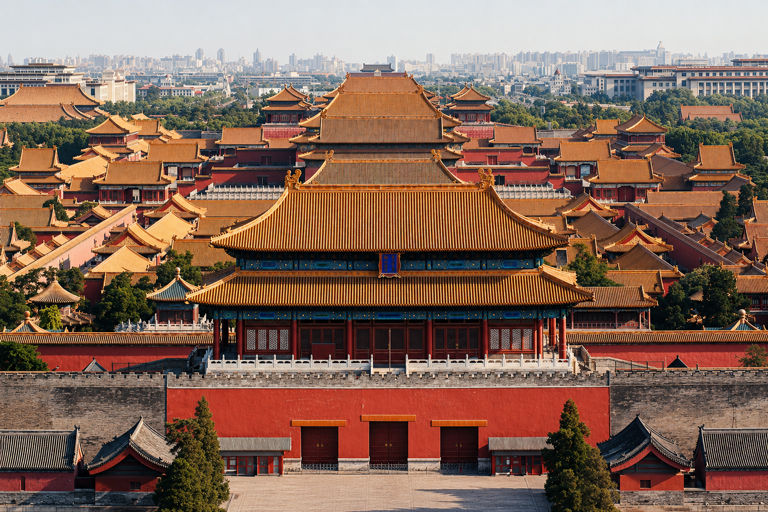
In many cultures, numbers carry symbolic meaning, but in China, numbers have long been woven in to architecture, philosophy, language, and even imperial power. Among them all, 9 stands apart.

Why Do Beijingers Ask “Have You Eaten?” Imagine walking through a quiet alley in Beijing. A friendly older neighbor sees you and smiles “吃了吗?” (Chī le ma?) — “Have you eaten?”

In Chinese culture, it’s the opposite. The family name comes first, followed by the personal name. So Wang Xiaoming means: Wang (王) = family name Xiaoming (小明) = personal name